Prophecy
Tyre: the rubble thrown into the sea (Ezekiel 26)
● Written before, according to historians
Written 587–586 BC according to tradition; c. 586–571 BC according to historians. Event: 586–332 BC.
See the full entry: sources, objections, answersIn short
The announcement. The prophet Ezekiel, in the book of Ezekiel, around 587–586 BC, announces the fall of Tyre, a city built partly on an island: its stones, its timber and its dust will be thrown into the sea, and it will not be rebuilt.
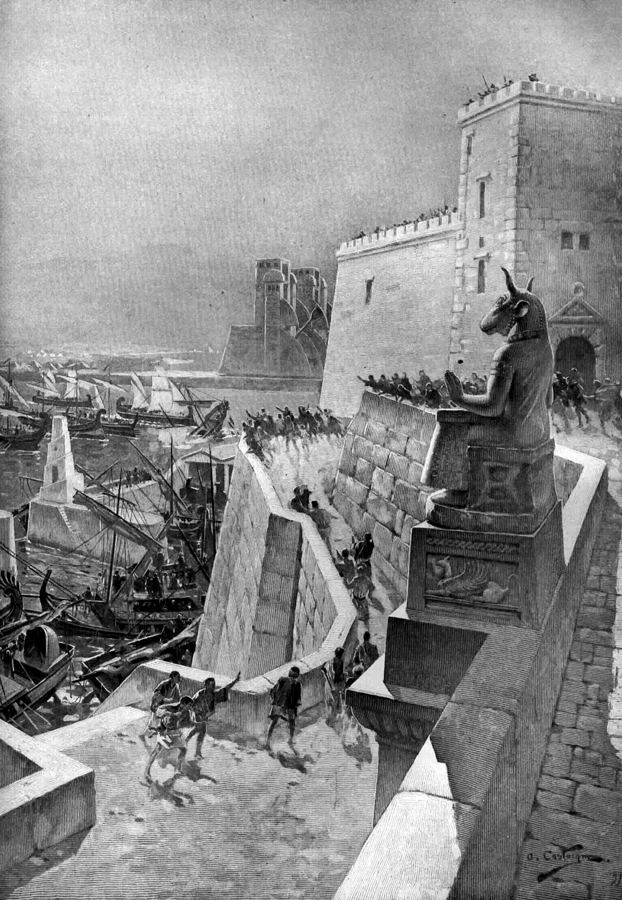
What happened. The king of Babylon, Nebuchadnezzar, besieges Tyre for many years without taking it, as the book of Ezekiel itself acknowledges. In 332 BC, Alexander builds with the rubble a causeway about one kilometer long to the island and takes the city, which has remained a peninsula ever since. But Tyre was rebuilt and today has more than a hundred thousand inhabitants.
What is still debated. the text attributed the capture of Tyre to Nebuchadnezzar, who failed, and nothing requires relating what follows to Alexander rather than to the Babylonian army.
Why it is striking
The text does date from before Alexander, and besieging one city by throwing another into the sea is an extremely rare technique; the island has remained a peninsula. It is still a reading: Ezekiel first had Nebuchadnezzar in view, who failed.
Main objection (in French for now)
Ez 26:7-11 attribue explicitement la prise et le pillage de Tyr à Nabuchodonosor. Or il ne l’a pas prise, et Ézéchiel lui-même le reconnaît en 571 (Ez 29:17-20) : pour beaucoup de critiques, c’est une prophétie corrigée par son propre auteur.
The text (World English Bible)
therefore the Lord GOD says, ‘Behold, I am against you, Tyre, and will cause many nations to come up against you, as the sea causes its waves to come up. They will destroy the walls of Tyre, and break down her towers. I will also scrape her dust from her, and make her a bare rock. She will be a place for the spreading of nets in the middle of the sea; for I have spoken it,’ says the Lord GOD. ‘She will become plunder for the nations.
Ezek 26:3-5
They will make a plunder of your riches and make a prey of your merchandise. They will break down your walls and destroy your pleasant houses. They will lay your stones, your timber, and your dust in the middle of the waters. I will cause the noise of your songs to cease. The sound of your harps won’t be heard any more. I will make you a bare rock. You will be a place for the spreading of nets. You will be built no more; for I the LORD have spoken it,’ says the Lord GOD.
Ezek 26:12-14
Sources
- Arrien, Anabase d’Alexandre II.18 (trad. E. J. Chinnock, 1884) — Wikisource (traduction du domaine public)
- Holocene morphogenesis of Alexander the Great’s isthmus at Tyre in Lebanon (Marriner, Morhange, Meulé) — PNAS 104(22):9218-9223
- Lebanon — Assyrian and Babylonian domination of Phoenicia — Encyclopaedia Britannica
- Reexamining Nebuchadnezzar II’s « Thirteen-Year » Siege of Tyre in Phoenician Historiography (Helen Dixon) — Journal of Ancient History (De Gruyter)
- Tyre — World Heritage List n° 299 — UNESCO World Heritage Centre
- Biblical literature — Ezekiel — Encyclopaedia Britannica
- Commentaires classiques sur Ézéchiel 29:18 (Ellicott, Keil-Delitzsch) — Bible Hub (commentaires du domaine public)
- Commentaires classiques sur Ézéchiel 26:12 (Jamieson-Fausset-Brown, Gill, Benson) — Bible Hub (commentaires du domaine public)