Prophecy
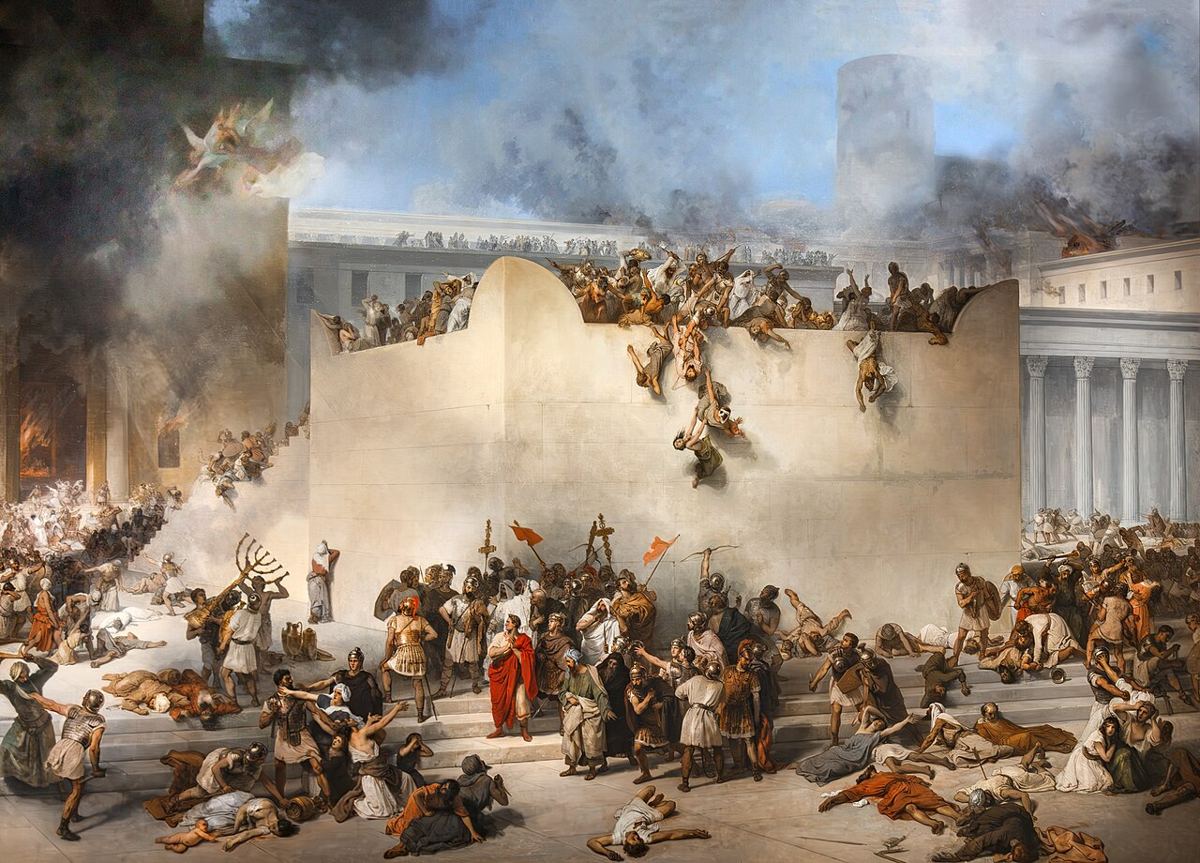
The Temple destroyed, the city surrounded, the flight (Matthew 24, Luke 19 and 21)
◐ Written shortly before or at the time: it cannot be decided
Written c. 30–62 AD according to tradition; c. 65–90 AD according to historians. Event: 66–70 AD.
See the full entry: sources, objections, answersIn short
The announcement. Jesus, in the Gospels of Matthew and Luke, around AD 30–33, announces that the Temple in Jerusalem will be destroyed and that the city will be surrounded by armies. He tells those who see this encirclement to flee to the mountains.
What happened. In 66, the Roman commander Cestius Gallus lifts the siege of Jerusalem “without any reason in the world”, according to the Jewish historian Josephus, which leaves an opportunity to flee. A 4th-century author reports that the Christians of Jerusalem then took refuge in Pella. In 70, Titus surrounds the city with a wall, then the Temple is burned.
What is still debated. if the Gospels were written around 70–90, their authors already knew of the fall of Jerusalem and may have added the details after the fact.
What would be striking if the text came first
In 66, the Roman army lifts the siege for no apparent reason, which leaves time to flee: it is Josephus, a Jewish historian who went over to Rome and not a Christian, who tells it. Around the year 30, nothing made the ruin of the Temple inevitable. But Luke may have been written after 70: impossible to settle.
Main objection (in French for now)
Prophétie après coup : si Marc date d’environ 70 et Luc de 80-90, les auteurs connaissaient la chute de Jérusalem. Les détails de Lc 19:43-44 et 21:20-24 pourraient avoir été ajoutés après l’événement.
The text (World English Bible)
Jesus went out from the temple, and was going on his way. His disciples came to him to show him the buildings of the temple. But he answered them, “You see all of these things, don’t you? Most certainly I tell you, there will not be left here one stone on another, that will not be thrown down.”
Matt 24:1-2
“When, therefore, you see the abomination of desolation, which was spoken of through Daniel the prophet, standing in the holy place (let the reader understand), then let those who are in Judea flee to the mountains.
Matt 24:15-16
“But when you see Jerusalem surrounded by armies, then know that its desolation is at hand. Then let those who are in Judea flee to the mountains. Let those who are in the middle of her depart. Let those who are in the country not enter therein.
Luke 21:20-21
Sources
- Flavius Josèphe, Guerre des Juifs 2.19.7 (trad. W. Whiston) — Perseus Digital Library, Tufts University
- Flavius Josèphe, Guerre des Juifs 5.12.2 (trad. W. Whiston) — Perseus Digital Library, Tufts University
- Eusèbe de Césarée, Histoire ecclésiastique, livre III (ch. 5, § 3) — New Advent (trad. NPNF2)
- The Western Wall: Ancient Herodian Street Along the Western Wall — Jewish Virtual Library, d’après le ministère israélien des Affaires étrangères
- Yeshiva University Project Shines a Colorful Digital Light on the Arch of Titus — Biblical Archaeology Society
- The Christian Flight to Pella: True or Tale? (Stephen Bourke) — Biblical Archaeology Review
- Siege of Jerusalem (70 CE) — Encyclopaedia Britannica
- Gospel According to Mark — Encyclopaedia Britannica