Prophecy
“The gates of Hades will not prevail”: the Church survives the Roman persecutions (Matthew 16:18)
○ Written after the events, according to historians; tradition dates it before
Written c. 30–62 AD according to tradition; c. 70–90 AD according to historians. Event: 64–313 AD.
See the full entry: sources, objections, answersIn short
The announcement. In the Gospel of Matthew, Jesus tells Peter, around 30-33, that he will build his Church and that “the gates of Hades” will not prevail against it.
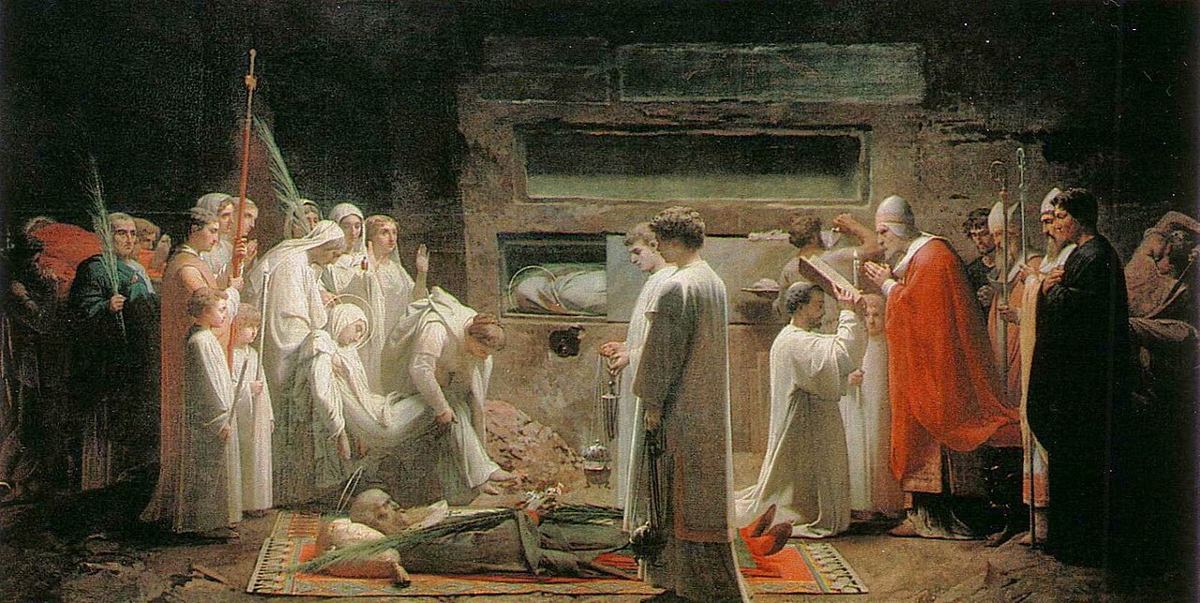
What happened. Christians are persecuted by Rome from 64, then massively from 303, when the Empire orders churches razed and the Scriptures burned. In 311, the emperor Galerius allows them to exist again, and in 313 Constantine and Licinius grant freedom of worship. The promise remains open beyond this period.
What is still debated. as long as the Church exists, the promise cannot be disproved, which makes it impossible to verify as a prediction.
What would be striking if the text came first
A movement born from a crucified convict survived two and a half centuries of persecution by the leading power of its time. Even if Matthew dates from after 70, as historians think, this outcome comes well after. The promise itself remains open beyond that.
Main objection (in French for now)
Promesse invérifiable par nature : tant que l’Église existe, elle « n’a pas été vaincue » ; aucun fait ne pourrait la réfuter, ce qui en fait un argument faible.
The text (World English Bible)
I also tell you that you are Peter, and on this rock I will build my assembly, and the gates of Hades will not prevail against it.
Matt 16:18
Sources
- Tacite, Annales XV, 44 (trad. J. Jackson, Loeb) — LacusCurtius (Bill Thayer), Université de Chicago
- Pline le Jeune, Lettres 10.96-97 (Pline à Trajan, réponse de Trajan) — York University (textes de cours, d'après le site CCAT de l'Université de Pennsylvanie)
- Diocletian and Christian Persecution (Encyclopaedia Romana) — Encyclopaedia Romana (James Grout), Université de Chicago
- Lactance, De la mort des persécuteurs, chap. 34-35 et 48 — New Advent (trad. Ante-Nicene Fathers)
- Gospel According to Matthew — Encyclopaedia Britannica
- Codex Sinaiticus — présentation du manuscrit — Codex Sinaiticus Project (British Library, Bibliothèque universitaire de Leipzig, monastère Sainte-Catherine, Bibliothèque nationale de Russie)
- Commentaires classiques sur Matthieu 16:18 (Ellicott, Barnes, JFB, Poole, Gill, Bible de Genève et al.) — Bible Hub (textes du domaine public)
- Tertullien, Apologétique, chap. 50 — New Advent (Ante-Nicene Fathers, vol. 3)