Prophecy
Moab “will cease to be a people” (Isaiah 15–16, Jeremiah 48)
◐ Written shortly before or at the time: it cannot be decided
Written c. 740–586 BC according to tradition; c. 715–500 BC according to historians. Event: 582–400 BC.
See the full entry: sources, objections, answersIn short
The announcement. The prophets Isaiah (around 740–700 BC) and Jeremiah (between 627 and 586 BC), in their books, announce that Moab, a kingdom east of the Dead Sea, will be devastated and “will cease to be a people”.
What happened. According to the Jewish historian Josephus, Nebuchadnezzar makes war on the Moabites in 582 BC. The kingdom never reappears, and the Moabite name and culture fade from the region in the Persian period. The return of Moab's captives, which Jeremiah also announces, has never been observed.
What is still debated. the only ancient source that dates the fall of Moab, Josephus, itself relies on Jeremiah, so this end has no independent witness.
What would be striking if the text came first
Jeremiah announces more than a defeat: Moab “will cease to be a people”. Judah, struck harder in 586, recovered; Moab did not. The texts come before or alongside this decline, but their exact date is debated, and no outside source confirms their author.
Main objection (in French for now)
La seule source antique qui date la chute de Moab (Josèphe, Ant. 10.181) présente elle-même l’événement comme l’accomplissement de Jérémie ; C. W. Tyson (2013) montre qu’elle dépend presque entièrement du texte biblique. L’accomplissement n’est donc pas attesté de façon indépendante.
The text (World English Bible)
Moab will be destroyed from being a people, because he has magnified himself against the LORD.
Jer 48:42
Of Moab. The LORD of Armies, the God of Israel, says: “Woe to Nebo! For it is laid waste. Kiriathaim is disappointed. It is taken. Misgab is put to shame and broken down. The praise of Moab is no more. In Heshbon they have devised evil against her: ‘Come! Let’s cut her off from being a nation.’ You also, Madmen, will be brought to silence. The sword will pursue you.
Jer 48:1-2
The destroyer will come on every city, and no city will escape; the valley also will perish, and the plain will be destroyed, as the LORD has spoken. Give wings to Moab, that she may fly and get herself away: and her cities will become a desolation, without anyone to dwell in them.
Jer 48:8-9
Sources
- Flavius Josèphe, Antiquités juives 10.181 (trad. W. Whiston) — Lexundria
- Craig W. Tyson, « Josephus, Antiquities 10.180–82, Jeremiah, and Nebuchadnezzar », Journal of Hebrew Scriptures 13, art. 7 — Journal of Hebrew Scriptures
- Moabite — Encyclopaedia Britannica
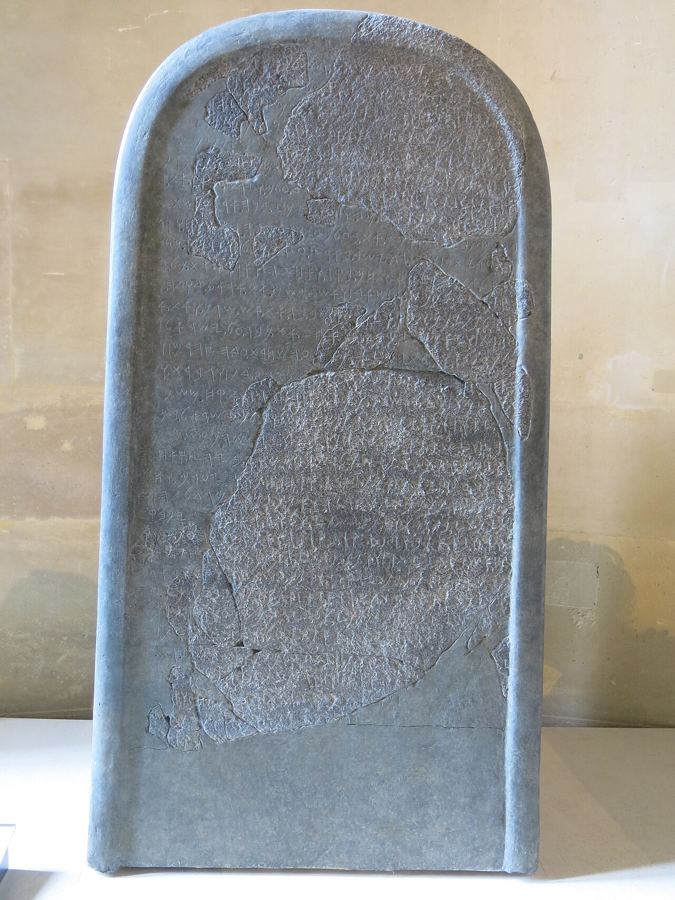
- Stèle de Mésha, roi de Moab (AO 5066) — Musée du Louvre, département des Antiquités orientales
- Grand rouleau d’Ésaïe (1QIsaᵃ), Digital Dead Sea Scrolls — Musée d’Israël, Jérusalem
- Commentaires sur Jérémie 48:42 (Ellicott, Poole, Gill, Keil-Delitzsch, Matthew Henry) — Bible Hub (textes de commentaires du domaine public)
- Commentaires sur Jérémie 48:47 (Keil-Delitzsch, Matthew Henry, Poole, Benson, JFB, Gill) — Bible Hub (textes de commentaires du domaine public)
- Mishna, Yadayim 4:4 — Sefaria (texte consulté via l’API v3)