Prophecy
Ahijah of Shiloh and the division of the kingdom (1 Kings 11)
○ Written after the events, according to historians; tradition dates it before
Written c. 935–931 BC according to tradition; c. 640–560 BC according to historians. Event: c. 931–928 BC.
See the full entry: sources, objections, answersIn short
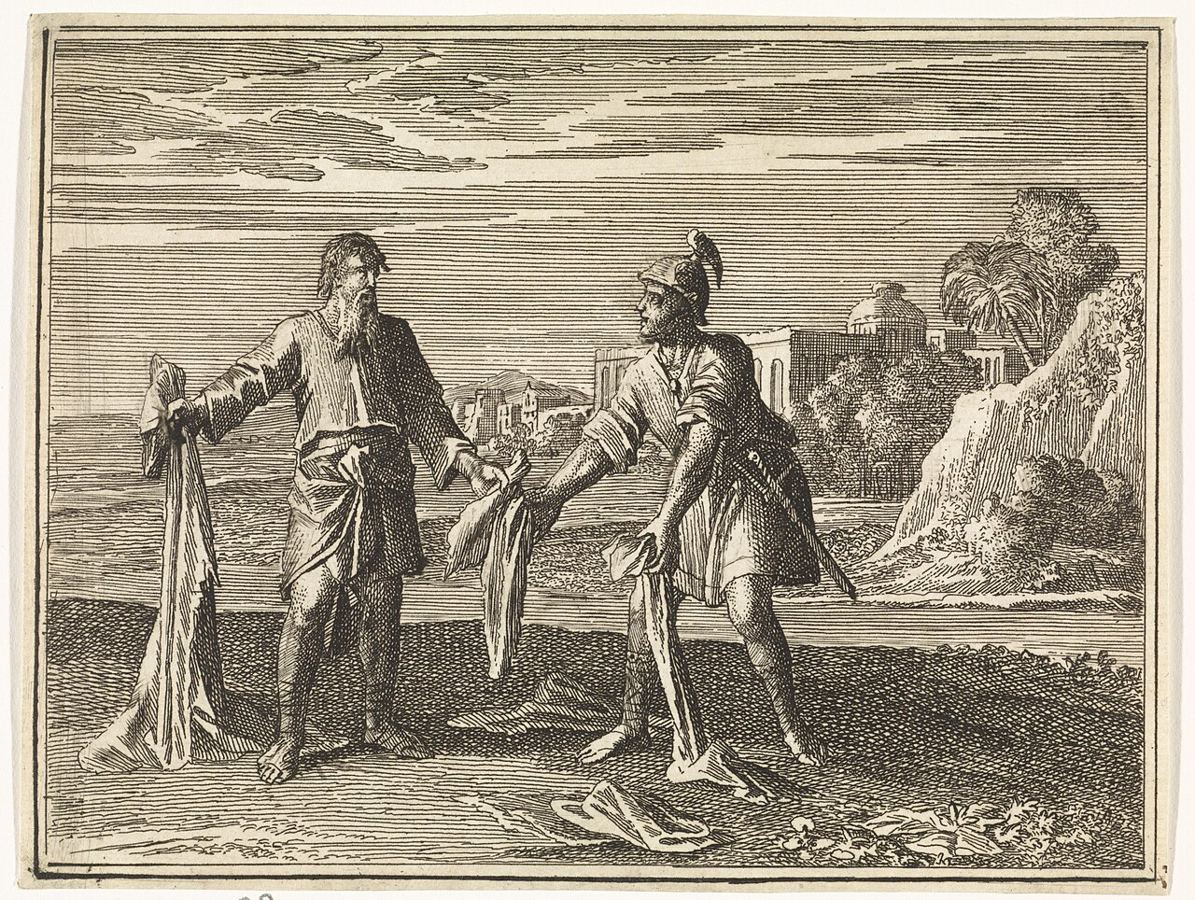
The announcement. The prophet Ahijah of Shiloh, in the first book of Kings, around 935–931 BC according to tradition, tears his cloak into twelve pieces and announces to Jeroboam that Solomon's kingdom will be divided and that he will receive ten tribes of it.
What happened. According to the Bible, at Solomon's death, around 931–928 BC, the northern tribes reject his son Rehoboam and make Jeroboam king. In the 9th century BC, Assyrian and Aramean sources clearly know two distinct states: Israel and the “house of David”.
What is still debated. the account was written about three centuries later, and the oracle may explain an already old division rather than foresee it.
What would be striking if the text came first
The announced division, a large kingdom in the north and a small one around Jerusalem, matches the map that lasted afterward, attested by enemies of both kingdoms. But according to historians, the text was written three centuries after the division.
Main objection (in French for now)
Le récit appartient à l’histoire deutéronomiste, rédigée trois siècles plus tard : l’oracle explique un partage déjà ancien, il ne le prévoit pas.
The text (World English Bible)
At that time, when Jeroboam went out of Jerusalem, the prophet Ahijah the Shilonite found him on the way. Now Ahijah had clad himself with a new garment; and the two of them were alone in the field. Ahijah took the new garment that was on him, and tore it in twelve pieces. He said to Jeroboam, “Take ten pieces; for the LORD, the God of Israel, says, ‘Behold, I will tear the kingdom out of the hand of Solomon and will give ten tribes to you (but he shall have one tribe, for my servant David’s sake and for Jerusalem’s sake, the city which I have chosen out of all the tribes of Israel), because they have forsaken me, and have worshiped Ashtoreth the goddess of the Sidonians, Chemosh the god …
1 Kgs 11:29-39
Sources
- The Deuteronomic History (David Miano) — My Jewish Learning
- Jeroboam (Bustanay Oded et al.) — Encyclopaedia Judaica (Gale), via Encyclopedia.com
- Salmanazar III, texte 2 : monolithe de Kurkh (RIMA 3 A.0.102.2) — ORACC, Royal Inscriptions of Assyria online (RIAo), d’après A. K. Grayson
- Tel Dan Stele, c. 840 BCE — Center for Online Judaic Studies
- Commentaires sur 1 Rois 11:32 (Keil-Delitzsch, Barnes, Cambridge, Pulpit, JFB, Matthew Henry) — Bible Hub (textes de commentaires du domaine public)