Prophecy
Micaiah son of Imlah and Ahab’s death at Ramoth (1 Kings 22)
○ Written after the events, according to historians; tradition dates it before
Written c. 853–852 BC according to tradition; c. 640–560 BC according to historians. Event: c. 853–852 BC.
See the full entry: sources, objections, answersIn short
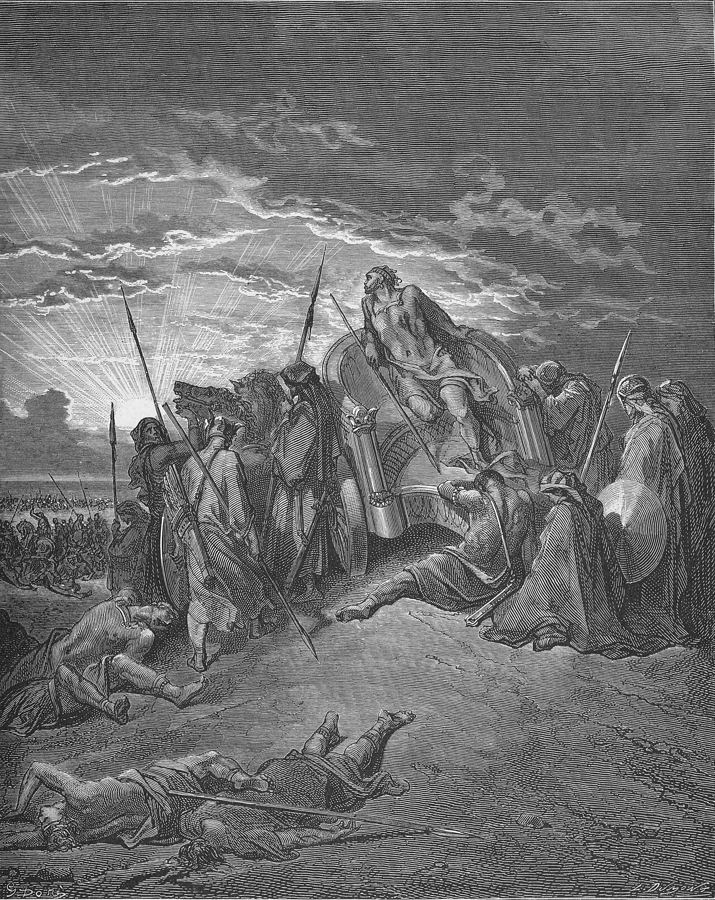
The announcement. The prophet Micaiah son of Imlah, in the first book of Kings, around 853 BC, announces to King Ahab that he will not return in peace from the battle of Ramoth and that Israel will be scattered like sheep without a shepherd.
What happened. According to the Bible, Ahab disguises himself, but an arrow shot at random wounds him, and he dies in the evening. An Assyrian monument confirms that Ahab was still reigning in 853 BC, but his death in battle is told only by the Bible.
What is still debated. the same account contains the announcement and its fulfillment, and some scholars think it originally concerned another king of Israel.
What would be striking if the text came first
Ahab dies despite his disguise, from an arrow shot “at random”, and Micaiah had staked his credibility on the outcome. But only the Bible tells of this death, in an account that historians date to two centuries later.
Main objection (in French for now)
En 853, Kurkh montre Achab allié de Damas contre l’Assyrie ; une guerre contre Aram la même année n’est pas impossible, mais elle demande une reconstruction.
The text (World English Bible)
He said, “I saw all Israel scattered on the mountains, as sheep that have no shepherd. The LORD said, ‘These have no master. Let them each return to his house in peace.’”
1 Kgs 22:17
The LORD said, ‘Who will entice Ahab, that he may go up and fall at Ramoth Gilead?’ One said one thing, and another said another.
1 Kgs 22:20
Micaiah said, “If you return at all in peace, the LORD has not spoken by me.” He said, “Listen, all you people!”
1 Kgs 22:28
Sources
- The Deuteronomic History (David Miano) — My Jewish Learning
- Ahab (Bustanay Oded, Harold Louis Ginsberg) — Encyclopaedia Judaica (Gale), via Encyclopedia.com
- Salmanazar III, texte 2 : monolithe de Kurkh (RIMA 3 A.0.102.2) — ORACC, Royal Inscriptions of Assyria online (RIAo), d’après A. K. Grayson
- Kurkh Stele, 853 BCE — Center for Online Judaic Studies
- Commentaires sur 1 Rois 22:1 (Pulpit, Ellicott, Barnes, Keil-Delitzsch) — Bible Hub (textes de commentaires du domaine public)
- Rashi sur 1 Rois 22:21 — Sefaria (texte consulté via l’API v3)
- Commentaires sur 2 Rois 22:20 (Benson, Barnes, Keil-Delitzsch, Pulpit, Ellicott, Matthew Henry, Gill) — Bible Hub (textes de commentaires du domaine public)