Prophecy
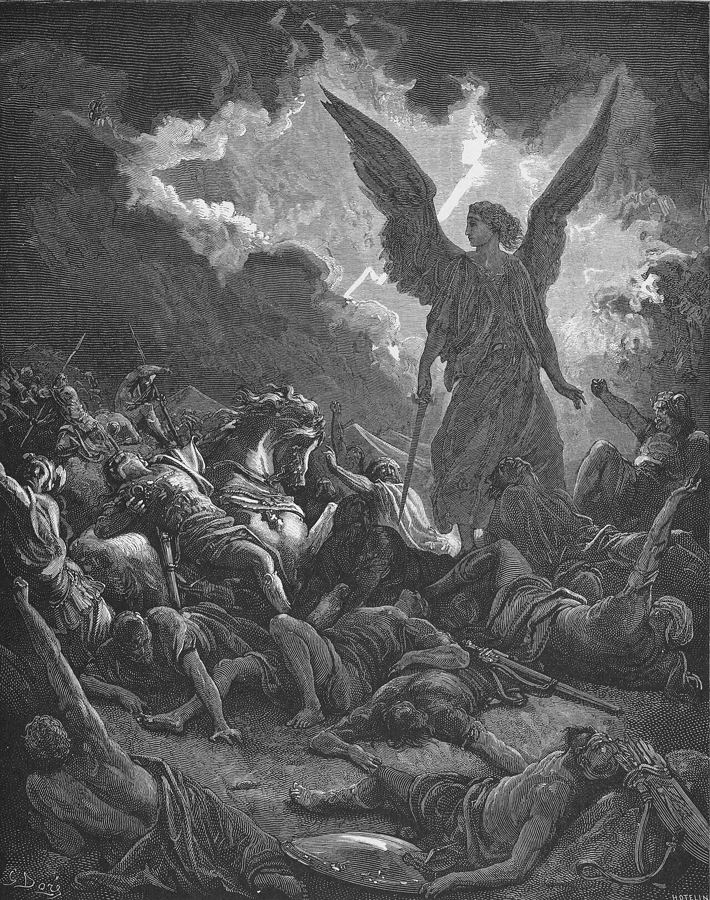
Sennacherib will not enter Jerusalem (Isaiah 37, 2 Kings 19)
○ Written after the events, according to historians; tradition dates it before
Written 701 BC according to tradition; c. 681–540 BC according to historians. Event: 701 BC.
See the full entry: sources, objections, answersIn short
The announcement. The prophet Isaiah, in the book of Isaiah and the second book of Kings, in 701 BC according to the account, announces that Sennacherib, king of Assyria, will not enter Jerusalem, will not shoot arrows there and will go back the way he came.
What happened. In 701 BC, according to his own annals, Sennacherib takes 46 fortified cities of Judah and carries off 200,150 people, but he does not take Jerusalem: he only keeps King Hezekiah there “shut up like a bird in a cage”. Hezekiah submits and pays a heavy tribute.
What is still debated. the account that contains the announcement may have been written long after the events, and the reason for the Assyrian army's withdrawal remains unknown.
What would be striking if the text came first
The confirmation comes from the enemy, who does not claim to have taken the city. Announcing that he would leave went against all the evidence: the country ravaged, Lachish fallen, tribute paid. Historians, however, date this passage to after the events; tradition, to the siege.
Main objection (in French for now)
Le récit qui contient l’oracle (Es 37:9b-35 // 2 R 19:9b-35, dit « récit B2 ») est attribué par N. Na’aman à un descendant de déportés judéens vivant en Babylonie dans la seconde moitié du VIe s. ; le récit B1 ne peut être antérieur au meurtre de Sennachérib (681). L’annonce n’est donc connue que par un texte écrit après l’événement.
The text (World English Bible)
“Therefore the LORD says concerning the king of Assyria, ‘He will not come to this city, nor shoot an arrow there, neither will he come before it with shield, nor cast up a mound against it. He will return the way that he came, and he won’t come to this city,’ says the LORD. ‘For I will defend this city to save it, for my own sake, and for my servant David’s sake.’”
Isa 37:33-35
Sources
- Prisme de Sennachérib dit « prisme Taylor » (BM 91032) — British Museum
- Sennacherib: The Invasion of Judah (prisme de Sennachérib et 2 R 18) — Internet Ancient History Sourcebook, Fordham University (d’après O. J. Thatcher, The Library of Original Sources, 1907)
- Hezekiah’s Defeat: The Annals of Sennacherib on the Taylor, Jerusalem, and Oriental Institute Prisms, 700 BCE — Center for Online Judaic Studies
- Room 10b: Assyria — Siege of Lachish — British Museum
- Hérodote, Histoires 2.141 (trad. G. C. Macaulay) — Lexundria
- New Light on Hezekiah’s Second Prophetic Story (2 Kgs 19,9b-35) (Nadav Na’aman) — Biblica 81 (2000), p. 393-402, Institut biblique pontifical
- Hezekiah (Encyclopaedia Britannica, 11e éd., 1911) — Wikisource, texte de l’Encyclopaedia Britannica de 1911
- Dating ancient manuscripts using radiocarbon and AI-based writing style analysis (Popović et al.) — PLOS ONE 20(6), DOI 10.1371/journal.pone.0323185