Prophecy
Lachish and Azekah, the last fortified cities of Judah (Jeremiah 34)
○ Written after the events, according to historians; tradition dates it before
Written c. 588–587 BC according to tradition; 588–550 BC according to historians. Event: 588–586 BC.
See the full entry: sources, objections, answersIn short
The announcement. The prophet Jeremiah, in the book of Jeremiah, around 588–587 BC, during the siege of Jerusalem, announces that the city will be burned and that the towns of Judah will become “a desolation without inhabitant”. The account specifies that Lachish and Azekah are then the last fortified cities still holding out.
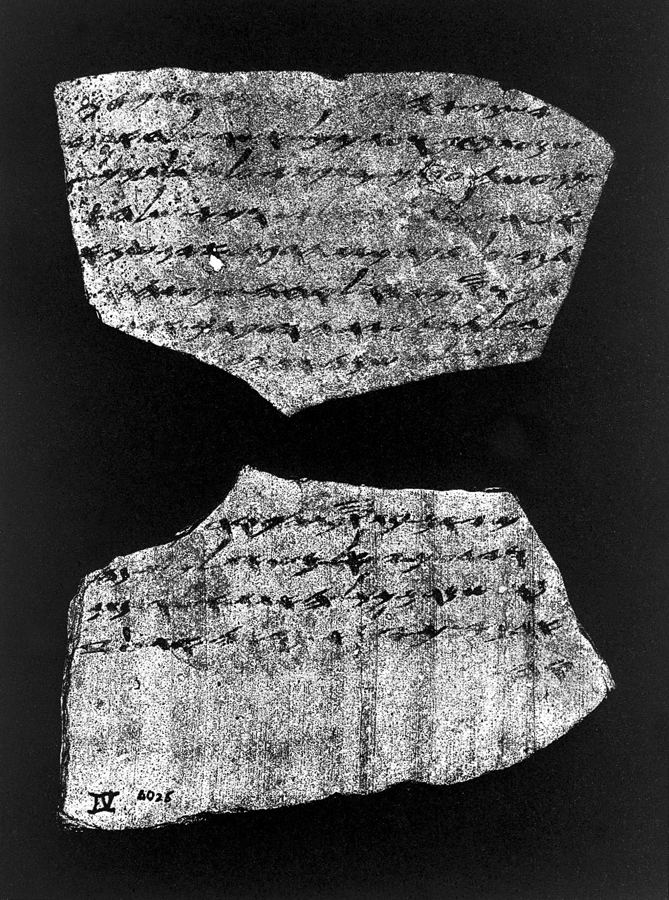
What happened. Lachish is destroyed by the Babylonians around 588–586 BC. In the ruins of its gate, letters written on pieces of pottery were found, in which an officer says he is watching for the signals of Lachish because he “cannot see Azekah”.
What is still debated. the announcement is made while the Babylonian army is already ravaging the country, and these letters confirm the setting of the account rather than the prediction itself.
What would be striking if the text came first
A military letter written during the war, around 588–586 BC, confirms exactly the situation Jeremiah describes. It attests the accuracy of the setting; the value as a prediction remains open, because historians think the account was put into its final form after 586.
Main objection (in French for now)
L’annonce est faite pendant le siège, quand l’armée babylonienne ravage déjà Juda : la destruction des villes fortes restantes n’avait rien d’imprévisible.
The text (World English Bible)
Behold, I will command,” says the LORD, “and cause them to return to this city. They will fight against it, take it, and burn it with fire. I will make the cities of Judah a desolation, without inhabitant.”
Jer 34:22
when the king of Babylon’s army was fighting against Jerusalem and against all the cities of Judah that were left, against Lachish and against Azekah; for these alone remained of the cities of Judah as fortified cities.
Jer 34:7
Sources
- Lachish — Jewish Virtual Library (d’après l’Encyclopaedia Judaica)
- Return to Lachish (Steven Feldman, avec David Ussishkin) — Biblical Archaeology Review 28:3 (2002), via Center for Online Judaic Studies
- The Lakhish Ostraca, c. 587 BCE — Center for Online Judaic Studies (trad. d’après H. Torczyner)
- The Lachish Letters (Nathan Steinmeyer) — Bible History Daily, Biblical Archaeology Society
- The Book of Jeremiah: a Work in Progress (Emanuel Tov) — Bible Review, juin 2000 (Biblical Archaeology Society)
- Commentaires classiques sur Jérémie 34:22 (Barnes, Jamieson-Fausset-Brown, Keil-Delitzsch, Gill) — Bible Hub (commentaires du domaine public)
- Commentaires classiques sur Jérémie 37:9 (Ellicott) — Bible Hub (commentaires du domaine public)