Prophecy
Coniah cast out to Babylon, no descendant on the throne (Jeremiah 22)
○ Written after the events, according to historians; tradition dates it before
Written 598–597 BC according to tradition; c. 597–540 BC according to historians. Event: 597–561 BC.
See the full entry: sources, objections, answersIn short
The announcement. The prophet Jeremiah, in the book of Jeremiah, around 598–597 BC, announces that King Coniah will be cast out to Babylon and that none of his descendants will sit on the throne of Judah.
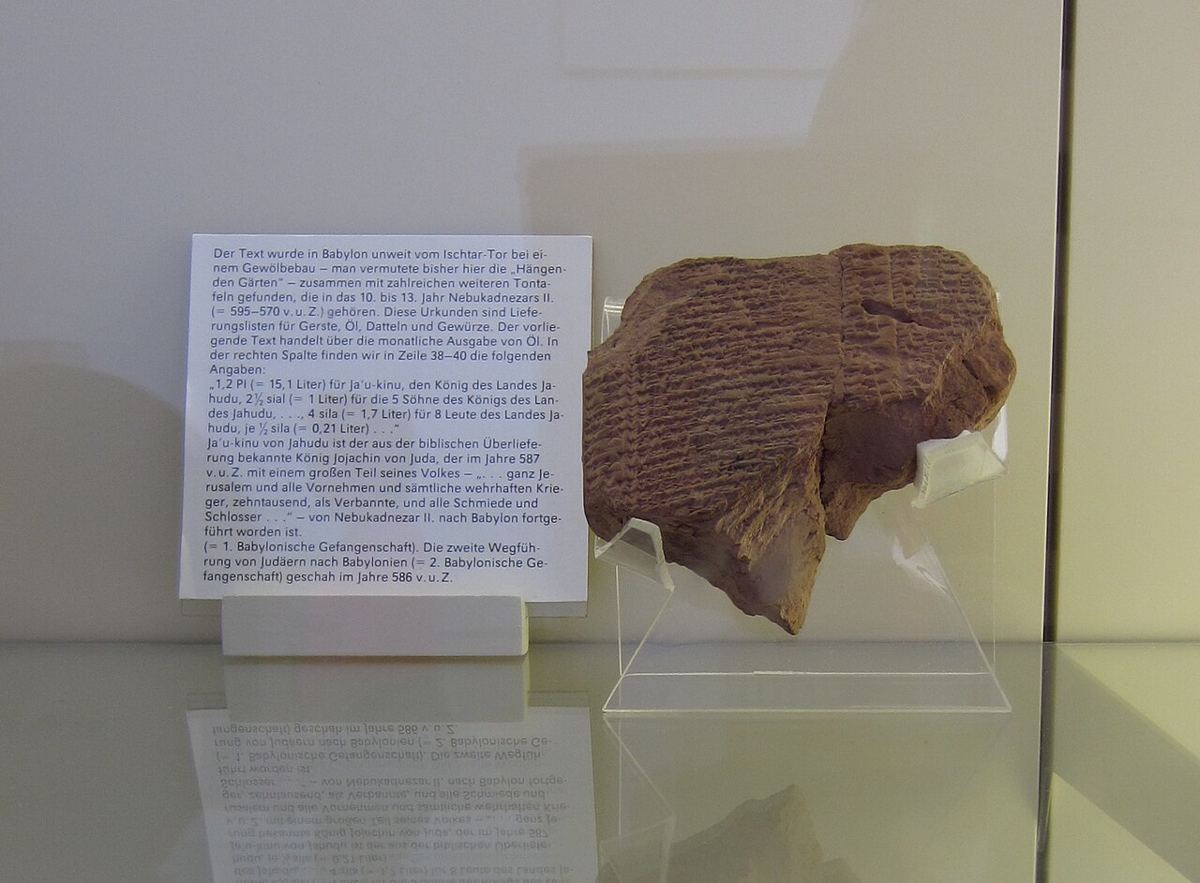
What happened. In 597 BC, Babylon takes Jerusalem and captures the king. In 592/591, tablets from the palace of Babylon name “Jehoiachin, king of the land of Judah”, and his five sons. None of his descendants reigned: his grandson Zerubbabel was only a governor.
What is still debated. the clause about his descendants may have been written after 586 BC, when the end of the monarchy was visible, and the text calls him “childless” although he had five children.
What would be striking if the text came first
Tablets from the palace of Babylon, the victor’s account books with no connection to the Bible, find the deported king Jehoiachin five years later. No descendant reigned afterward, as announced; this clause may, however, have been written when the failure was visible.
Main objection (in French for now)
« Inscrivez cet homme comme privé d’enfants » (Jr 22:30) est contredit à la lettre par les tablettes de Babylone, qui lui donnent cinq fils en 592/591, et par 1 Ch 3:17-18. Le verset ne s’accorde qu’en lisant la suite comme son explication : privé d’héritier sur le trône.
The text (World English Bible)
“As I live,” says the LORD, “though Coniah the son of Jehoiakim king of Judah were the signet on my right hand, I would still pluck you from there. I would give you into the hand of those who seek your life, and into the hand of them of whom you are afraid, even into the hand of Nebuchadnezzar king of Babylon, and into the hand of the Chaldeans. I will cast you out with your mother who bore you into another country, where you were not born; and there you will die. But to the land to which their soul longs to return, there they will not return.”
Jer 22:24-27
Is this man Coniah a despised broken vessel? Is he a vessel in which no one delights? Why are they cast out, he and his offspring, and cast into a land which they don’t know? O earth, earth, earth, hear the LORD’s word! The LORD says, “Record this man as childless, a man who will not prosper in his days; for no more will a man of his offspring prosper, sitting on David’s throne and ruling in Judah.”
Jer 22:28-30
Sources
- ABC 5 (Chronique de Jérusalem) — Livius.org, d’après A. K. Grayson
- Babylonian Ration List: King Jehoiakhin in Exile, 592-1 BCE — Center for Online Judaic Studies
- Jehoiachin (Encyclopaedia Judaica, art. de Jacob Liver) — Jewish Virtual Library, d’après l’Encyclopaedia Judaica (Gale, 2008)
- Flavius Josèphe, Contre Apion 1.145-153, citant Bérose (trad. W. Whiston) — Lexundria
- The Book of Jeremiah: a Work in Progress (Emanuel Tov) — Bible Review, juin 2000 (Biblical Archaeology Society)
- Commentaires classiques sur Jérémie 22:30 (Ellicott) — Bible Hub (commentaires du domaine public)
- Talmud de Babylone, Sanhédrin 37b (William Davidson Edition) — Sefaria
- Commentaires classiques sur Matthieu 1:12 (Ellicott) — Bible Hub (commentaires du domaine public)