Prophecy
Hezekiah’s treasures and sons carried off to Babylon (Isaiah 39)
○ Written after the events, according to historians; tradition dates it before
Written c. 712–702 BC according to tradition; 597–540 BC according to historians. Event: 597–586 BC.
See the full entry: sources, objections, answersIn short
The announcement. The prophet Isaiah, in the book of Isaiah, around 712–702 BC according to tradition, announces to King Hezekiah that all his treasures will be carried off to Babylon and that some of his descendants will serve there in the king's palace.
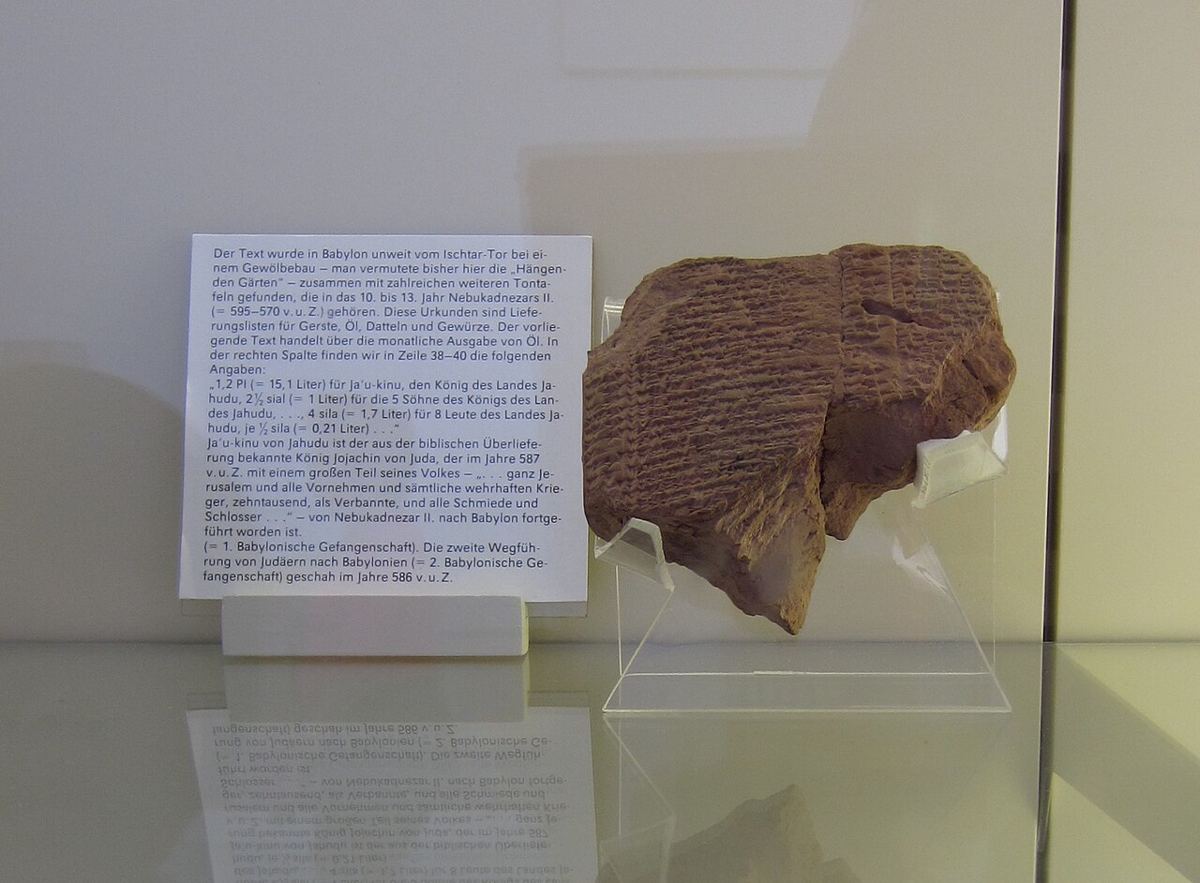
What happened. In 597 BC, a Babylonian chronicle reports that Babylon takes Jerusalem, captures its king and carries off its heavy tribute. In 592/591, tablets from the palace of Babylon record the rations of the deported king of Judah and of five of the king's sons. In 586, according to the Bible, the bronze of the Temple is carried off in turn.
What is still debated. many historians think this account was written during the exile, after 597 BC, when the transfer of the treasures to Babylon was already a fact.
What would be striking if the text came first
In Hezekiah’s time, Babylon is a rebel kingdom that Assyria is crushing, more an ally of Jerusalem than a threat. But historians often date this account to the exile, after 597: in that case, the author already knew what followed.
Main objection (in French for now)
Pour la critique historique, le récit appartient à l’histoire deutéronomiste achevée pendant l’exil : l’auteur écrit après 597, quand le transfert des trésors et des princes à Babylone était déjà un fait.
The text (World English Bible)
Then Isaiah said to Hezekiah, “Hear the word of the LORD of Armies: ‘Behold, the days are coming when all that is in your house, and that which your fathers have stored up until today, will be carried to Babylon. Nothing will be left,’ says the LORD. ‘They will take away your sons who will issue from you, whom you shall father, and they will be eunuchs in the king of Babylon’s palace.’”
Isa 39:5-7
Sources
- ABC 5 (Chronique de Jérusalem) — Livius.org, d’après A. K. Grayson
- Babylonian Ration List: King Jehoiakhin in Exile, 592-1 BCE — Center for Online Judaic Studies
- Jehoiachin (Encyclopaedia Judaica, art. de Jacob Liver) — Jewish Virtual Library, d’après l’Encyclopaedia Judaica (Gale, 2008)
- ABC 1, colonne ii (Chronique de Nabû-nasir à Šamaš-šuma-ukin) — Livius.org, d’après A. K. Grayson
- Hezekiah (Encyclopaedia Britannica, 11e éd., 1911) — Wikisource, texte de l’Encyclopaedia Britannica de 1911
- Dating ancient manuscripts using radiocarbon and AI-based writing style analysis (Popović et al.) — PLOS ONE 20(6), DOI 10.1371/journal.pone.0323185
- Commentaires classiques sur Ésaïe 39:6 (Pulpit Commentary) — Bible Hub (commentaires du domaine public)
- Talmud de Babylone, Sanhédrin 93b (William Davidson Edition) — Sefaria