Prophecy
Damascus and Samaria plundered by the king of Assyria (Isaiah 7–8)
● Written before, according to historians
Written c. 735–734 BC according to tradition; c. 734–732 BC according to historians. Event: 732–720 BC.
See the full entry: sources, objections, answersIn short
The announcement. The prophet Isaiah, in the book of Isaiah, around 735–734 BC, announces that before a child knows how to say “My father! My mother!”, the riches of Damascus and the spoil of Samaria will be carried away before the king of Assyria.
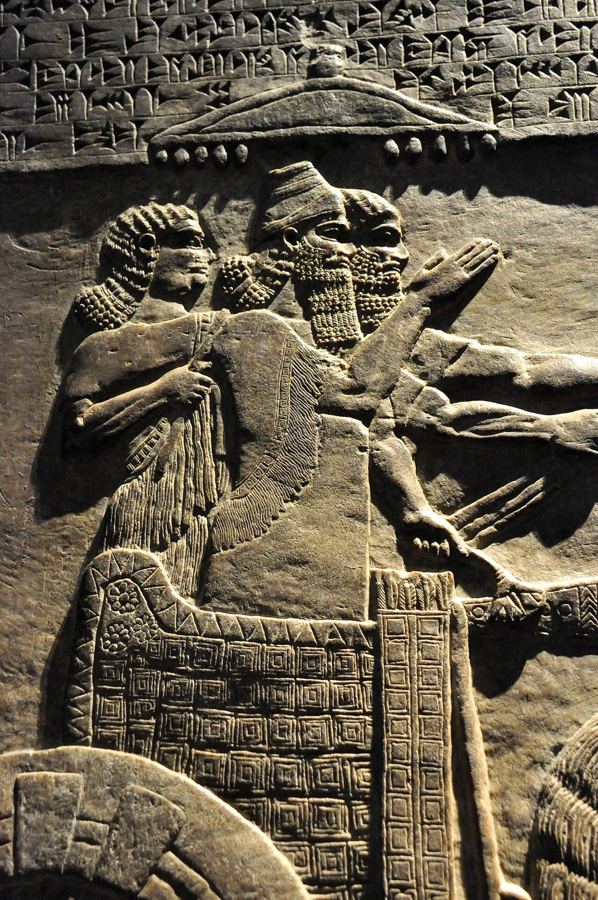
What happened. The Assyrian king Tiglath-Pileser III takes Damascus in 732 BC, two or three years after the announcement. Samaria is ravaged around 722–720 BC, and the Assyrian king Sargon II says he deported 27,290 of its inhabitants.
What is still debated. Assyria was already crushing the neighboring kingdoms, and an informed observer could reasonably bet on the defeat of Damascus.
Why it is striking
Historians themselves date this text to before the events, and the announced time frame is short, so it can be checked. Assyrian inscriptions confirm the fall of both kingdoms. A well-informed observer could, however, bet on an Assyrian victory.
Main objection (in French for now)
La prédiction était politiquement prévisible : Achaz venait d’appeler Tiglath-Piléser III à l’aide (2 R 16:7-9), et l’Assyrie écrasait les coalitions syro-palestiniennes. Un observateur informé pouvait parier sur la défaite de Damas.
The text (World English Bible)
This is what the Lord GOD says: “It shall not stand, neither shall it happen.” For the head of Syria is Damascus, and the head of Damascus is Rezin. Within sixty-five years Ephraim shall be broken in pieces, so that it shall not be a people. The head of Ephraim is Samaria, and the head of Samaria is Remaliah’s son. If you will not believe, surely you shall not be established.’”
Isa 7:7-9
For before the child knows to refuse the evil and choose the good, the land whose two kings you abhor shall be forsaken.
Isa 7:16
For before the child knows how to say, ‘My father’ and ‘My mother,’ the riches of Damascus and the plunder of Samaria will be carried away by the king of Assyria.”
Isa 8:4
Sources
- Tiglath-pileser III’s Campaigns in 734-732 B.C.: Historical Background of Isa 7; 2 Kgs 15–16 and 2 Chr 27–28 (Peter Dubovský) — Biblica 87 (2006), p. 153-170, Institut biblique pontifical
- ABC 1 (Chronique de Nabû-nasir à Šamaš-šuma-ukin) — Livius.org, d’après A. K. Grayson
- The Annals of Sargon II, c. 722 BCE — Center for Online Judaic Studies
- A New Historical Reconstruction of the Fall of Samaria (Sung Jin Park) — Biblica 93 (2012), p. 98-106, Institut biblique pontifical
- « Within sixty-five years » (Es 7:8b), note — The Bible Translator 51 (2000), p. 440-447 (PDF hébergé par translation.bible)
- Rachi sur Ésaïe 7:8 — Sefaria
- Dating ancient manuscripts using radiocarbon and AI-based writing style analysis (Popović et al.) — PLOS ONE 20(6), DOI 10.1371/journal.pone.0323185
- Commentaires classiques sur Ésaïe 7:8 (Ellicott) — Bible Hub (commentaires du domaine public)