Prophecy
The Persian ram, the Greek goat and the four horns (Daniel 8)
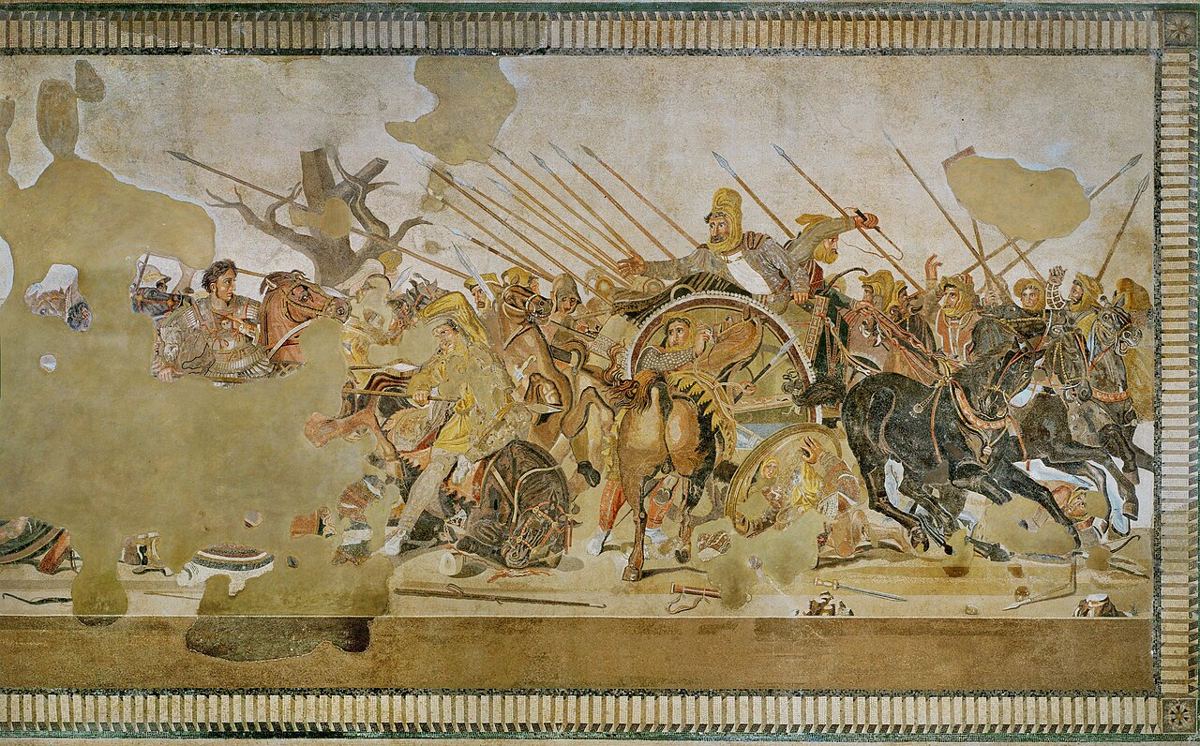
○ Written after the events, according to historians; tradition dates it before
Written c. 551–549 BC according to tradition; c. 167–164 BC according to historians. Event: 334–164 BC.
See the full entry: sources, objections, answersIn short
The announcement. The prophet Daniel, in the book of Daniel, around 550 BC according to tradition, sees a ram, “the kings of Media and Persia”, overthrown by a goat, “the king of Javan”, that is, Greece. The goat's great horn breaks, four others replace it, then comes a king who puts an end to the Temple worship.
What happened. Alexander overthrows the Persian empire from 334 BC onward and dies in 323, at 32, at the height of his power. After 301, his empire is divided among four kings. In 167 BC, Antiochus IV stops the sacrifices and profanes the Temple, which is purified in 164.
What is still debated. for most historians, the book was completed around 167–164 BC, so everything before that was already history known to the author.
What would be striking if the text came first
If the chapter does date from 550 BC, as tradition holds, it tells two centuries in advance of Alexander, his death at 32 and the division of his empire, in order. Historians instead date it to 167–164 BC.
Main objection (in French for now)
Datation critique majoritaire : le livre est achevé vers 167–164 av. J.-C. ; tout ce qui précède Antiochos IV serait donc de l’histoire connue de l’auteur. L’argument remonte à Porphyre, au IIIe siècle, rapporté par Jérôme.
The text (World English Bible)
As I was considering, behold, a male goat came from the west over the surface of the whole earth, and didn’t touch the ground. The goat had a notable horn between his eyes. He came to the ram that had the two horns, which I saw standing before the river, and ran on him in the fury of his power. I saw him come close to the ram, and he was moved with anger against him, and struck the ram, and broke his two horns. There was no power in the ram to stand before him; but he cast him down to the ground and trampled on him. There was no one who could deliver the ram out of his hand. The male goat magnified himself exceedingly. When he was strong, the great horn was broken; and instead of it there…
Dan 8:5-8
The ram which you saw, that had the two horns, they are the kings of Media and Persia. The rough male goat is the king of Greece. The great horn that is between his eyes is the first king. As for that which was broken, in the place where four stood up, four kingdoms will stand up out of the nation, but not with his power.
Dan 8:20-22
Sources
- Arrian on the death of Alexander — Livius.org (Jona Lendering)
- The battle of Ipsus — Livius.org
- Antiochus IV Epiphanes — Encyclopaedia Britannica
- 1 Maccabées, chapitre 4 (NABRE, avec notes) — United States Conference of Catholic Bishops
- Dating ancient manuscripts using radiocarbon and AI-based writing style analysis (Popović et al.) — PLOS ONE 20(6), DOI 10.1371/journal.pone.0323185
- Redating the Dead Sea Scrolls and the Book of Daniel (I. Young, G. Wearne, E. Caddy) — The Bible and Interpretation (University of Arizona)
- Contribution of the Dead Sea Scrolls to Textual Criticism and Understanding of the Canonical Book of Daniel (M. Nel) — Nederduitse Gereformeerde Teologiese Tydskrif 47(3)
- The Book of Daniel (Old Testament) — Encyclopaedia Britannica