Prophecy
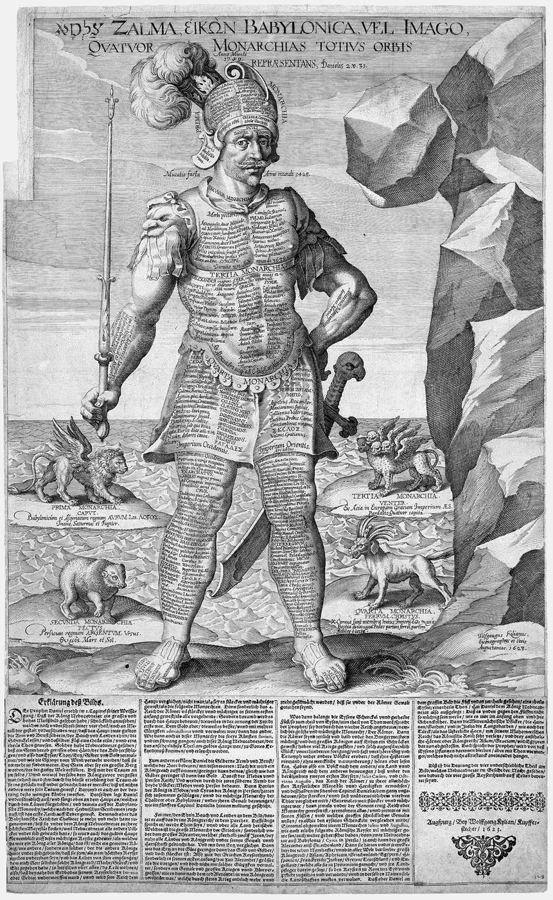
The statue of four metals: four kingdoms, then a kingdom that will never be destroyed (Daniel 2)
○ Written after the events, according to historians; tradition dates it before
Written c. 603 BC according to tradition; c. 167–164 BC according to historians. Event: 539–63 BC.
See the full entry: sources, objections, answersIn short
The announcement. The book of Daniel tells how the prophet Daniel, around 603 BC according to the account, explains to King Nebuchadnezzar the dream of a statue made of four metals: four kingdoms will follow one another, then God will set up a kingdom that will never be destroyed. Scholars date the completion of the book to around 167–164 BC.
What happened. Babylon passes to the Persians in 539 BC, then the Persian empire falls to Alexander the Great, who dies in 323 BC. For the traditional reading, the fourth kingdom is Rome, which takes Jerusalem in 63 BC. For many historians, it is the Greek empire, and the expected kingdom of God has not come.
What is still debated. the identity of the fourth kingdom, Rome or the Greek empire, which the text does not name.
What would be striking if the text came first
The first three follow real history (Babylon, Persia, Greece), but historians date the book to 167–164 BC, after these events. Only the fourth could go beyond that date, if it is Rome, master of Judea in 63: an ancient reading, but a disputed one.
Main objection (in French for now)
Lecture critique majoritaire : les quatre royaumes sont Babylone, la Médie, la Perse et l’empire grec (notes de la NABRE). Le livre place en effet un « Darius le Mède » (Dn 5:31) avant « Cyrus le Perse » (Dn 6:28) : l’auteur semble compter un royaume mède distinct, ce qui met la Grèce en quatrième position.
The text (World English Bible)
“You, O king, saw, and behold, a great image. This image, which was mighty, and whose brightness was excellent, stood before you; and its appearance was terrifying. As for this image, its head was of fine gold, its chest and its arms of silver, its belly and its thighs of bronze, its legs of iron, its feet part of iron and part of clay. You saw until a stone was cut out without hands, which struck the image on its feet that were of iron and clay, and broke them in pieces. Then the iron, the clay, the bronze, the silver, and the gold were broken in pieces together, and became like the chaff of the summer threshing floors. The wind carried them away, so that no place was found for them. The…
Dan 2:31-35
“This is the dream; and we will tell its interpretation before the king. You, O king, are king of kings, to whom the God of heaven has given the kingdom, the power, the strength, and the glory. Wherever the children of men dwell, he has given the animals of the field and the birds of the sky into your hand, and has made you rule over them all. You are the head of gold. “After you, another kingdom will arise that is inferior to you; and another third kingdom of bronze, which will rule over all the earth. The fourth kingdom will be strong as iron, because iron breaks in pieces and subdues all things; and as iron that crushes all these, it will break in pieces and crush. Whereas you saw the …
Dan 2:36-45
Sources
- The Book of Daniel (Old Testament) — Encyclopaedia Britannica
- Jérôme, Commentaire sur Daniel (trad. G. L. Archer, 1958) — tertullian.org (Roger Pearse)
- Daniel, chapitre 2 (NABRE, avec notes) — United States Conference of Catholic Bishops
- Contribution of the Dead Sea Scrolls to Textual Criticism and Understanding of the Canonical Book of Daniel (M. Nel) — Nederduitse Gereformeerde Teologiese Tydskrif 47(3)
- ABC 7 (Chronique de Nabonide) — Livius.org, d’après A. K. Grayson, Assyrian and Babylonian Chronicles
- Arrian on the death of Alexander — Livius.org (Jona Lendering)
- Flavius Josèphe, Antiquités juives 14.4.4 (trad. W. Whiston) — Perseus Digital Library, Tufts University
- Flavius Josèphe, Antiquités juives 10.10.4 (trad. W. Whiston) — Perseus Digital Library, Tufts University